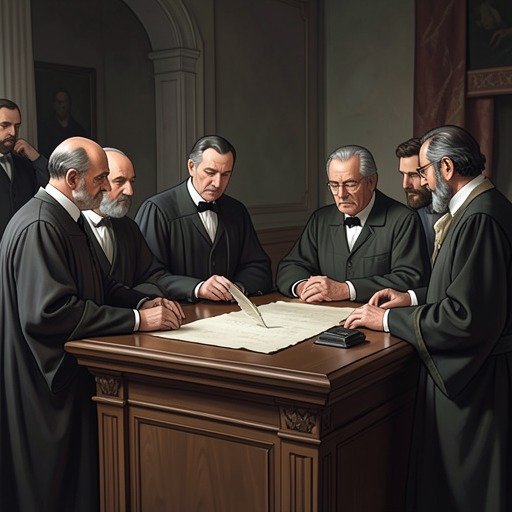
House–Senate Impeachment Relationship
Federalist PapersThe House–Senate Impeachment Relationship assigns distinct but connected roles to the two chambers of Congress: the House of Representatives originates impeachment by preferring charges, and the Senate judges the accused. In the account defended in The Federalist, this arrangement makes impeachment a national inquiry and a legislative restraint on executive power, while separating accusation from judgment to protect both the accused and the public.
Impeachment as a National Inquiry
The defense begins by identifying impeachment as a method of national inquiry into the conduct of public officials. Because the inquiry concerns the public reputation and political standing of those who administer government, it requires a tribunal capable of acting for the nation rather than merely for a faction. The argument therefore treats the legislative branches not simply as lawmakers but as representatives entrusted to investigate public conduct.
The House’s role is to originate the inquiry—to prefer the impeachment. The Senate is admitted to a share in that inquiry by judging the charge. The two chambers thus participate in one process without exercising the same function: one accuses, the other decides. The relationship rests on a division of responsibility, not on a duplication of authority.
A Legislative Check on Executive Officers
Impeachment is described as a bridle held by the legislative body upon the executive servants of government. The House’s power to bring charges gives the legislature a means to investigate and accuse public officers; the Senate’s trial role supplies a judgment on that accusation. This division makes the process a check on executive conduct while keeping the judgment from the hands of the chamber that initiated the prosecution.
The arrangement is linked to the broader principle that governmental powers need constitutional means and institutional motives to resist encroachment. In the proposed system, the two chambers do not merely share legislative authority: their separate roles in impeachment create an additional safeguard against executive abuse. Yet the check is structured rather than unchecked, because accusation by one chamber does not itself amount to conviction.
Why Judgment Belongs to the Senate
The Senate is defended as a tribunal with sufficient dignity and independence to hear an impeachment. The argument asks what other body could be confident enough in its institutional position to preserve impartiality between an individual accused and the people’s representatives, who are the accusers. The concern is practical as well as constitutional: a decision that conflicts with an accusation brought by the people’s immediate representatives may require a tribunal with enough standing for the public to accept its judgment.
The proposed division also draws on established examples. In Great Britain, the House of Commons prefers impeachment and the House of Lords decides it; several state constitutions follow the same pattern. These precedents support the separation of accusation and decision as a recognizable institutional design, rather than an arbitrary combination of legislative and judicial functions.
Safeguards Against Faction and Concentrated Power
Dividing the process between the chambers avoids making the same people both accusers and judges. The separation is intended to guard against persecution driven by a faction dominant in either branch: one chamber may bring the charge, but the other must judge it. A two-thirds concurrence in the Senate is additionally required for condemnation, providing a further protection for innocence by demanding more than a bare majority for conviction.
The arrangement is presented as a limited, purposeful intermixture of governmental functions, compatible with keeping the departments distinct in their main operation. The legislature’s impeachment power checks the executive, while the division between its own branches constrains how that power can be used. Its significance lies in this double structure: impeachment can hold public officers to account, but the route from accusation to judgment is divided so that the power to accuse cannot by itself determine the outcome.